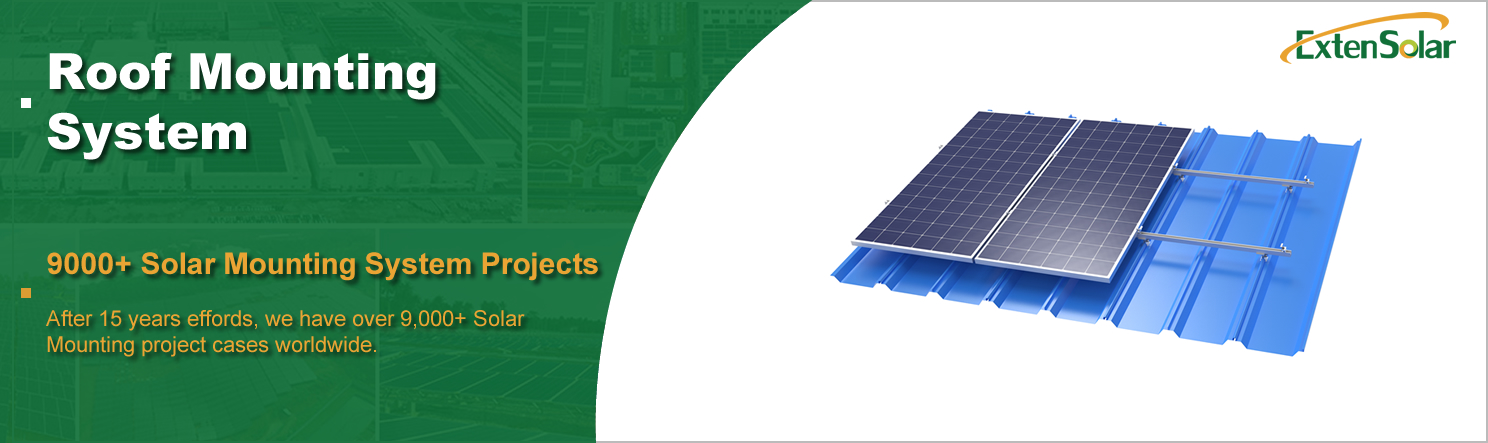
Details
| Surface Treatment |
Anodized |
Material |
Aluminum Alloy 6005-T5 |
| Place of Origin |
China |
Installation Site |
Open Field |
| Brand Name |
Exten |
Model Number |
A02-1 |
| Standard |
|
Certificate |
AS/NZS1170.2/CE/ISO |
| Wind Load |
60m/s(196.85ft/s) |
Module Orientation |
Landscape Portrait |
| Wind speed |
Yo 60m/s |
Max Snow Load |
1.4KN/m2 |
| Snow Load |
1.4KN/m2(29.24psf) |
Service Life |
25YRS |
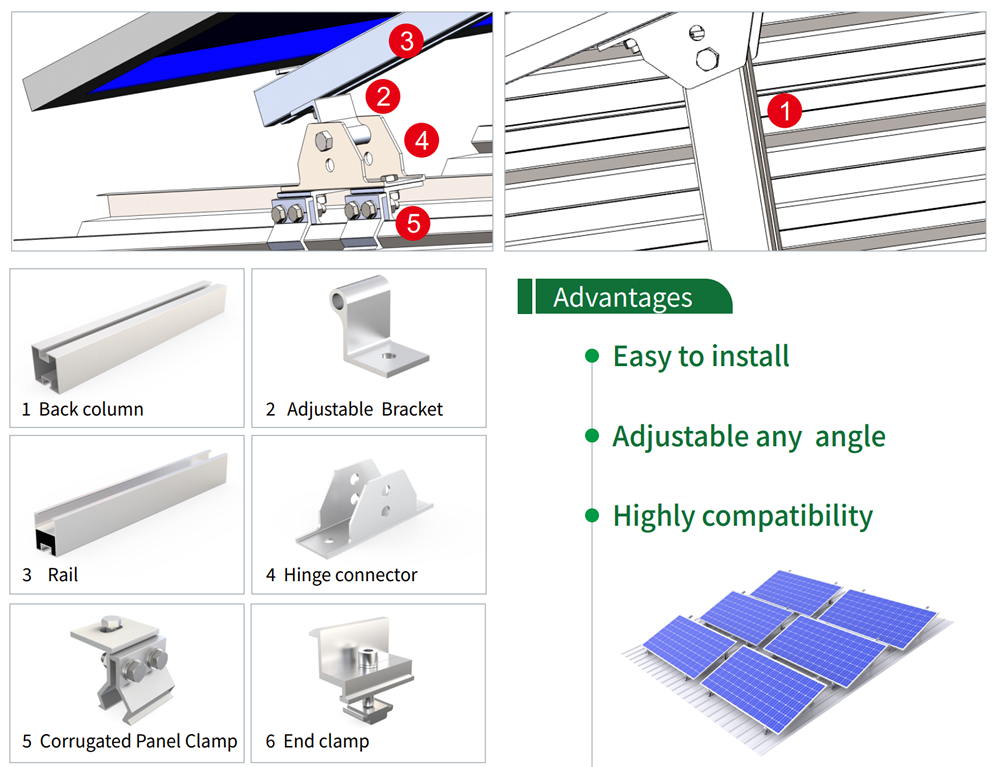
What is Metal Roof Solar Mounting System?Metal Roof Solar Mounting Systems for color-coated steel roofs are a specialized structural system designed to install photovoltaic modules on profiled metal roofs. This type of roofing is widely used in industrial plants, logistics centers, and large commercial buildings, characterized by long spans and large surface areas.
Since color-coated steel roofing consists of thin-walled, lightweight structures, mounting brackets via drilling or counterweights is not feasible. Engineers have therefore developed specialized clamping solutions that secure the system by gripping the corrugated peaks or standing seam structures of the roofing panels. This method avoids penetrating the roof at any point, fundamentally preserving the roof’s integrity and waterproofing performance.
Solar Panel Mounts for Metal Roof Advantages
The advantages of metal roof solar mounts are evident across multiple dimensions, each of which directly impacts the project’s safety, cost-effectiveness, and long-term operational benefits.
First, outstanding structural safety. The clamp-based installation solution does not penetrate the roof at all; it involves no drilling, no nailing, and no damage to the metal sheet’s surface coating. This is crucial—the greatest concern with color-coated steel sheet roofs is water leakage. Once a hole is made, rainwater seeping into the insulation layer can cause rust to spread, resulting in extremely high repair costs. Adopting the clamp solution effectively eliminates the risk of water leakage at its source.
Second, structural loads are controllable. Since the components are installed in a flat, parallel configuration with the roof and the brackets are low-profile, the additional load placed on the roof is minimal, typically kept to around 15 kilograms per square meter. This weight falls within the load-bearing capacity of most color-coated steel sheet roofs, eliminating the need for additional structural reinforcement and saving significant retrofitting costs.
Third, installation is efficient and quick. Both the clamps and the rail system feature a modular design, with key connectors pre-assembled at the factory. On-site installation requires only three steps: positioning the clamps, laying the rails, and securing the modules. Compared to solutions that require drilling holes in the roof or pouring foundations, the construction cycle can be shortened by 30% to 50%. For commercial and industrial property owners, this translates to shorter downtime and a faster return on investment.
Fourth, the system offers strong adaptability. The market provides specialized clamps for various roof tile types—including trapezoidal, angular, and standing seam tiles—with proven, compatible solutions for each. This flexible adaptability allows a single bracket brand to cover the vast majority of color-coated steel roof projects.
Fifth, easy maintenance. The system is reversible; if components need to be replaced or the roof inspected later, the clamps and rails can be removed and reinstalled. Some quick-installation structures even allow a single person to quickly assemble and disassemble components, significantly reducing operation and maintenance costs. Overall, color-coated steel roof mounting systems strike a good balance between safety, cost-effectiveness, and flexibility, and have become the standard configuration for distributed PV projects on light-gauge steel roofs.
Metal Roof Solar Mounts Installation
Step 1: Site Survey and Design. Engineers must verify the type of roof tiles, the structural load capacity, and the roof orientation, and then develop a mounting bracket layout and module array plan based on local wind pressure data.
Step 2: Clamp Installation. Installers place specialized clamps at the crests of the color-coated steel roof panels according to the drawings and tighten them to the specified torque using a torque wrench. The clamps must fit snugly against the corrugations; no drilling or penetration of the roof is permitted throughout the process.
Step 3: Rail Installation. Aluminum alloy rails are secured to the clamps using connectors to form parallel support tracks. A level is used to calibrate the installation, ensuring the entire frame is level and that the rail spacing matches the module width.
Step 4: Module Installation. Photovoltaic modules are hoisted onto the rails one by one and secured using pressure blocks or clips, ensuring that expansion gaps are left between adjacent modules to accommodate thermal expansion and contraction.
Step 5: Electrical Connection and Acceptance. Complete the string wiring and grounding system installation, test the open-circuit voltage and polarity, and finally verify the torque of all fasteners. Clean up the site and submit the acceptance record. The entire process is highly modular and allows for rapid construction; a skilled team can complete small- to medium-sized commercial and industrial rooftop projects within a few days.
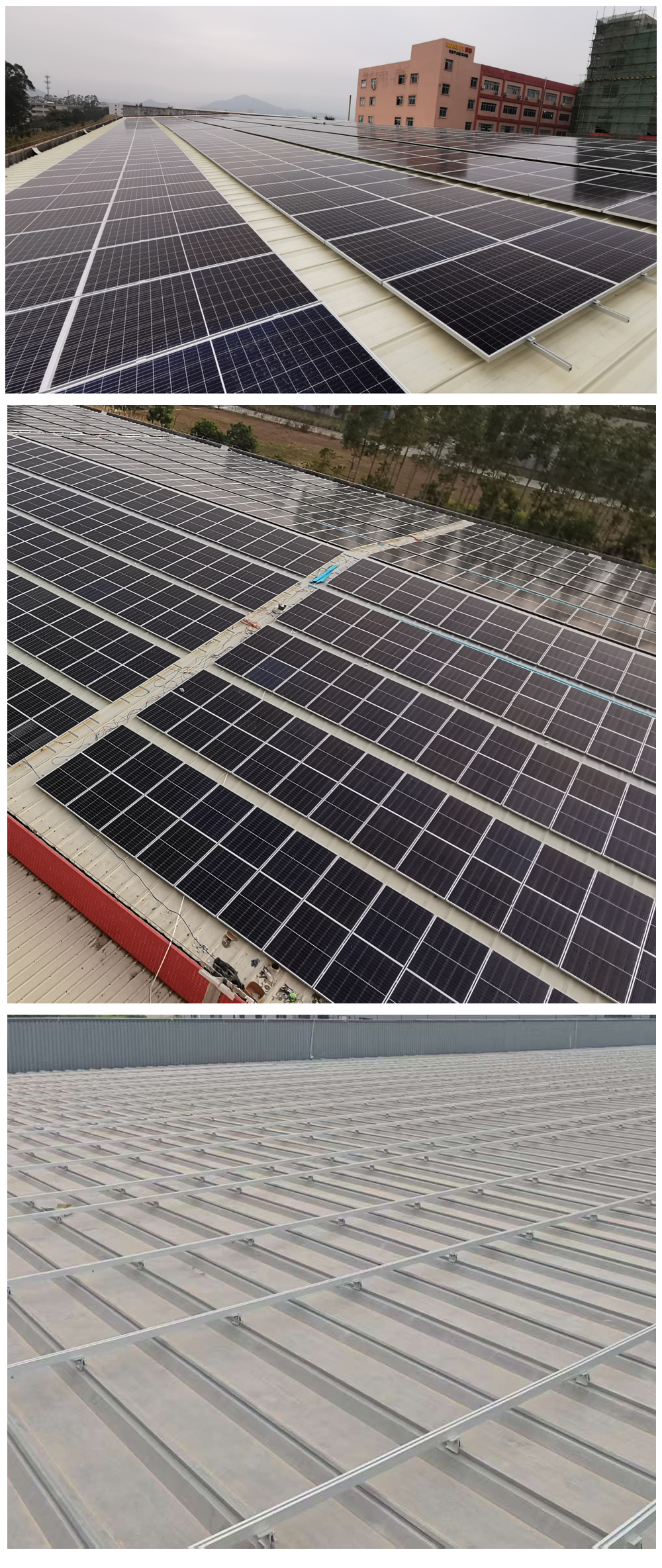
Solar Panel Mounting System for Metal Roof Case
FAQ
Q1: Will installing the clamps damage the roof’s waterproofing layer? Will it cause leaks?
No. This is the core value of this system. The clamps are secured to the corrugated peaks via mechanical clamping; the entire process involves no drilling, no nailing, and no penetration of any roofing materials. For different types of color-coated steel roofing—trapezoidal, angular, or standing seam—there are specially designed clamps that securely grip the original roof structure, leaving the roof’s original waterproofing performance completely unaffected.
Q2: How are the panels typically arranged? Can the angle be adjusted?
In the vast majority of cases, panels are installed flat, meaning they are parallel to the roof surface. This is primarily based on two considerations: first, a flat installation imposes the least additional load on the roof, eliminating the need for structural reinforcement; second, increasing the tilt angle exposes the panels to greater wind loads under strong wind conditions. However, for color-coated steel tile roofs with a gentle slope, there are also angle-adjustable mounting bracket solutions available on the market that allow for fine-tuning within a range of 5 to 10 degrees. This can increase power generation by approximately 5% without significantly increasing the risk of wind loads. The specific solution requires a comprehensive assessment based on the roof’s structural load capacity and meteorological conditions.
Q3: What materials are used for the mounting brackets? How long do they last?
The main material is typically high-strength aluminum alloy, most commonly grade 6063-T5, while fasteners are made of stainless steel. Aluminum alloy is lightweight, effectively reducing the load on the roof, and offers excellent corrosion resistance, performing well in environments where acid or alkali corrosion may occur, such as on industrial plant roofs. A high-quality system typically has a design service life of over 20 years and comes with a 10-year warranty. In recent years, some manufacturers have begun using glass-fiber-reinforced composite materials to manufacture the guide rails. These offer lower costs and lighter weight while maintaining good weather resistance and structural strength.
Q4: Is installation fast?
Yes, it is very fast. Because the clamps and guide rail systems are modular in design, most connectors are pre-assembled at the factory. On-site installation requires only three main steps: positioning the clamps, laying the guide rails, and securing the components. Compared to solutions that require drilling holes in the roof or pouring foundations, construction time can be reduced by 30% to 50%. For commercial and industrial property owners, this means less operational disruption and a faster return on investment.
Q5: Is maintenance convenient? How do you replace a faulty component?
It’s very convenient. The system is reversible, and all connectors are removable and standard-sized. If a faulty component needs to be replaced, simply loosen the corresponding clamps or latches, remove the old component, install the new one, and tighten it back in place—the entire process can be performed by a single person. If extensive roof repairs or renovations are required, the mounting system can be completely dismantled and reinstalled upon completion; most materials and components can be reused, eliminating unnecessary waste.


