During the design phase of a solar power plant, every engineer faces this classic question: Should the modules be arranged vertically or horizontally?
This is never a matter of aesthetic preference, but rather an economic calculation that must be thoroughly analyzed. Let’s cut straight to the heart of the matter and thoroughly examine the pros and cons from these key perspectives.
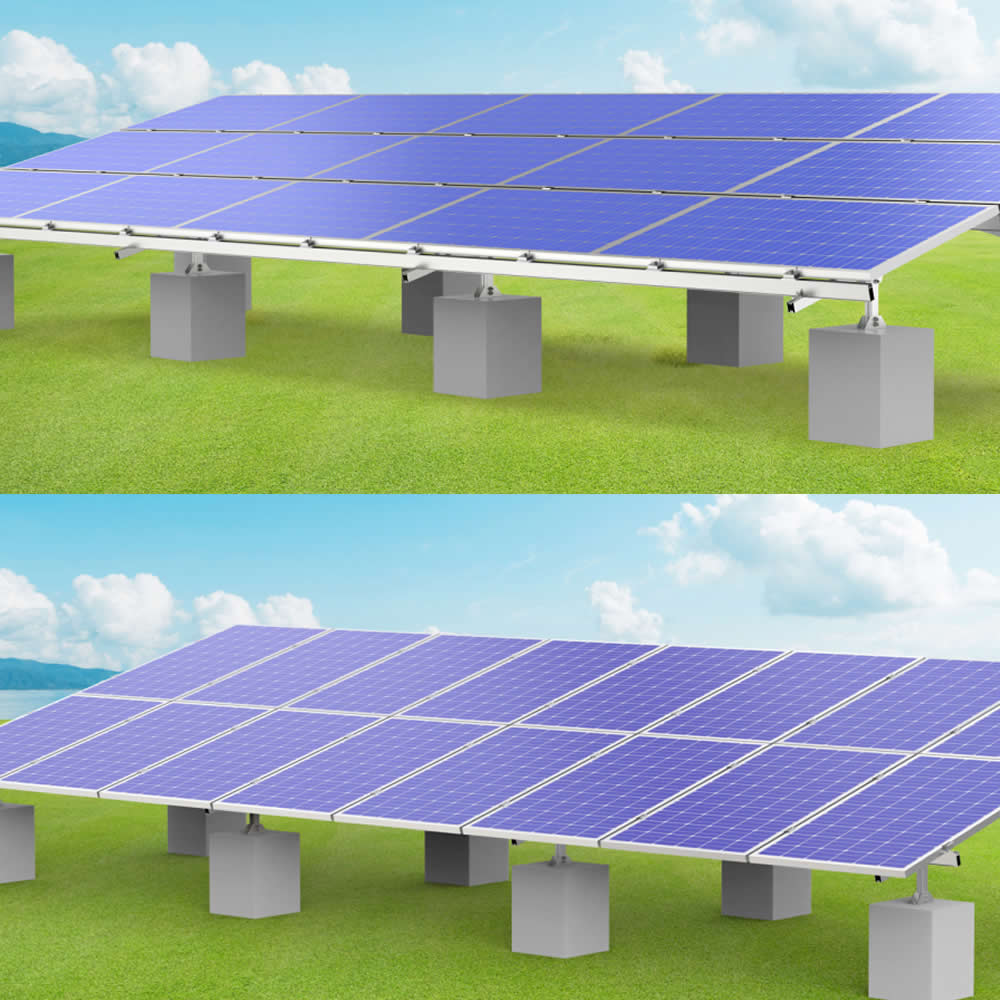
1. Differences in Power Generation Efficiency
This is the central battleground in the vertical vs. horizontal debate, with the differences primarily stemming from how the circuit responds to shading.
When sunlight is at an angle in the morning or evening, or when shadows from the front row of mounts sweep across, shading occurs primarily at the bottom of the modules. In a vertical orientation, a horizontal shadow covers every string of cells simultaneously, causing the bypass diodes to conduct en masse, and the module’s output power may instantly drop to near zero. In a horizontal orientation, the same shadow typically obscures only the bottommost string of cells, while the other two strings continue to operate normally, allowing the module to retain approximately two-thirds of its output.
Simply put, in the early morning or evening, or on sites with complex terrain, horizontal orientation can effectively mitigate power generation losses caused by shading. However, this difference is now narrowing—with the widespread adoption of half-cell modules and multi-busbar technology, shading losses associated with vertical orientation have been significantly reduced. Comparative data from actual power plants confirms this: on flat, unobstructed ground, the difference in annual power generation between horizontal and vertical orientations is less than 1.5%; however, in mountainous areas or projects with limited spacing between rows, horizontal orientation can recover an additional 1% to 2% of power generation. Whether this trade-off is worth it depends entirely on your site conditions.
2. What’s the Difference in Footprint?
Here, we need to dispel a widespread misconception. Many people intuitively assume that landscape orientation takes up more space, but in reality, assuming the same tilt angle, the same number of modules, and the same spacing between rows, the total footprint of landscape and portrait orientations is virtually identical.
Why? Because the spacing between rows is determined by the highest point of the array and the sun’s altitude angle, and has no direct relationship with whether the modules are oriented horizontally or vertically. What truly affects the footprint is the total width and height of the modules, while orientation simply rotates the same area by 90 degrees. Therefore, if you only change the orientation without altering the array layout, the footprint remains the same. Only in certain special configurations—such as two rows of horizontally oriented modules versus three rows of vertically oriented modules—will there be slight differences, but that falls under array design considerations and has nothing to do with the orientation itself.
3. Suitable Scenarios for Each Orientation
The advantage of vertical orientation lies in installation efficiency. When workers handle and secure modules, holding them vertically is the most natural and requires no extra turning or adjusting of their grip. This is particularly true for large-scale, flat-ground power plants, where construction speed can be significantly increased. Therefore, if you’re working on an open, flat, and unobstructed site and aiming to optimize construction timelines and labor costs, vertical orientation is the default choice.
The value of horizontal orientation, on the other hand, lies in “shaded” areas. For projects on mountainous or sloped terrain, or sites with fixed obstructions such as utility poles or walls, horizontal orientation minimizes the impact of shadows. Additionally, in low-latitude regions where shadows are longer in the morning and evening, the benefits of horizontal orientation in mitigating shading are even more pronounced. A practical tip: If your site is flat and there is sufficient spacing between rows, vertical mounting is perfectly fine; if the site is uneven or has potential for shading, prioritize horizontal mounting.
4. Cost Differences
First, let’s discuss the amount of steel used in the mounting structure. After structural optimization, the difference in steel usage between horizontal and vertical mounting under equivalent wind pressure and snow loads is very small—typically within 2%—and can be considered negligible.
The real cost differences stem from two factors. First is installation labor: vertical mounting is about 5% to 8% faster than horizontal mounting because the process is more intuitive and requires no additional tools—a tangible savings in regions with high labor costs. Second is cabling: in certain array layouts, horizontal mounting can shorten the busbar path, saving a small amount of DC cable, but the savings are minimal—typically just a few cents per watt. Overall, the upfront construction costs for vertical mounting are slightly lower. However, if horizontal mounting can recoup more than 1% in power generation, this cost difference will be quickly offset—or even reversed—over the plant’s full lifecycle.
5. Summary
There is no absolute “right” or “wrong” between vertical and horizontal mounting; it’s a matter of suitability. Vertical mounting is the “cost-effective” choice—it’s faster to install, saves on labor, and delivers comparable power output on good sites; Horizontal orientation is the “stability-first” choice—sacrificing a small amount of initial convenience in exchange for stronger shade tolerance and a more stable power generation curve. The starting point for decision-making always comes down to three questions: Is the site subject to shading? Are labor costs high? How tight is the required return on investment (ROI) timeline? Once these three questions are clearly answered, the orientation will naturally be determined.
6. Choosing Yiteng
Optimizing module orientation requires more than just theory—it demands deep integration of the mounting system, site conditions, and electrical compatibility. Yiteng has accumulated a vast amount of real-world project data in the solar mounting field and can provide customized layout solutions for different terrains and module types—from structural calculations to construction guidance—ensuring that every watt of power generated is achieved through the optimal solution. Choosing
Yiteng means choosing a partner that has a deep-seated attention to detail.
7. FAQ
Q1: Does horizontal orientation always generate more power than vertical orientation?
Not necessarily. Horizontal orientation only offers an advantage when shading is present; on flat, unobstructed sites, the difference between the two is minimal.
Q2: Does the module’s technology type affect this choice?
Yes. Newer module types—such as half-cell, multi-busbar, and shingled modules—have significantly reduced sensitivity to shading, which further narrows the power generation disadvantage of vertical orientation.
Q3: Does horizontal orientation place higher demands on the strength of the mounting structure?
No. Structural engineers design mounting structures based on wind pressure and snow loads; orientation has little bearing on this. As long as the design is appropriate, both configurations offer equally reliable safety.
Q4: How do the two configurations affect operations and maintenance?
Horizontal orientation typically provides slightly more clearance between the bottom of the modules and the ground, offering more space for cleaning and maintenance, but the difference is minor and not a decisive factor.
Q5: How should one choose if the site has both flat and sloped areas?
A zoned design is possible: use vertical orientation on flat areas to save costs, and horizontal orientation on sloped areas to reduce shading risks. This hybrid approach is already standard practice in many large-scale projects.


